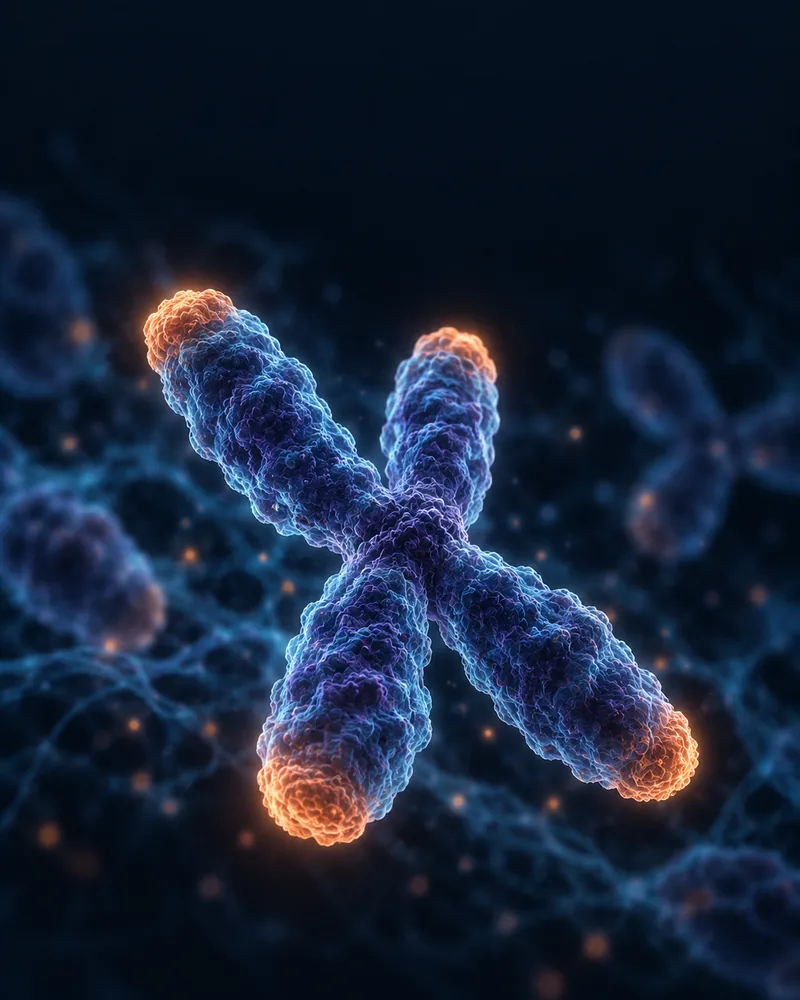
Telomeres are caps, not genes. They are long, repeating runs of the same short DNA sequence (in humans the unit TTAGGG repeated thousands of times) sitting at the tip of every chromosome. They carry no instructions of their own; their entire job is to mark where the chromosome legitimately ends so the cell's repair machinery does not treat that end as a snapped strand of DNA that needs emergency gluing. A capped end is a safe end; an uncapped or critically short end looks like damage.
The end-replication problem is why they shrink. Every time a cell divides it must copy all of its DNA, but the copying machine cannot quite finish the very tip of each strand, so a small piece of telomere is lost with each division. Over many divisions, and faster under oxidative stress (chemical wear from reactive oxygen species, the unstable oxygen byproducts of normal metabolism), the cap steadily erodes. This is the molecular reason most human cells can only divide a limited number of times, a ceiling first described as the Hayflick limit.
The shelterin complex keeps the cap hidden and safe. A set of six cooperating proteins called shelterin binds along the telomere and tucks the very end into a protective loop, which physically hides it from the cell's DNA-damage sensors. When telomeres are long, shelterin keeps the end invisible and quiet; when they grow too short or shelterin is disrupted, the end becomes exposed and the alarm system fires.
Telomerase can rebuild the cap, but most adult cells keep it switched off. Telomerase is the specialized enzyme that adds telomere DNA back onto chromosome ends; it is built from a protein part (TERT) and an RNA template (TERC) that tells it which sequence to lay down. It runs at meaningful levels in egg and sperm cells, in early embryos, and in some stem and immune cells, but most ordinary adult body cells deliberately keep it nearly silent. That silence is a feature, not a bug: it is one of the body's brakes against cancer, because a cell that cannot endlessly rebuild its telomeres cannot easily divide without limit.
Critically short telomeres trigger replicative senescence and instability. Once a telomere erodes past a threshold, its end is exposed, and the same damage-sensor proteins used for double-strand DNA breaks (ATM and ATR) switch on. They activate the master switch protein p53, which through a stop protein called p21 locks the cell out of further division, producing replicative senescence (a permanent non-dividing state) or ordering self-destruction. If those checkpoints are bypassed, exposed ends can instead fuse to one another and tear apart during the next division, scrambling the genome and feeding genomic instability.
The cancer tradeoff is the heart of this hallmark. In a healthy cell, telomere shortening is a safety timer that retires damaged cells. But roughly nine in ten cancers escape that timer by switching telomerase back on (a minority use an alternative pathway instead), which lets the tumor cell rebuild its caps and divide without end. That is exactly why aggressively forcing telomerase activity higher across the body is a double-edged idea rather than a clean rejuvenation lever.
Inherited short-telomere syndromes show what happens at the extreme. People born with mutations in telomere-maintenance genes (such as TERT, TERC, or DKC1) cannot keep their caps long enough, and their high-turnover tissues fail early. These telomere biology disorders, including dyskeratosis congenita, produce premature bone-marrow failure, lung scarring, and liver disease, a natural experiment that confirms telomere maintenance genuinely matters for tissue health, not just in theory.