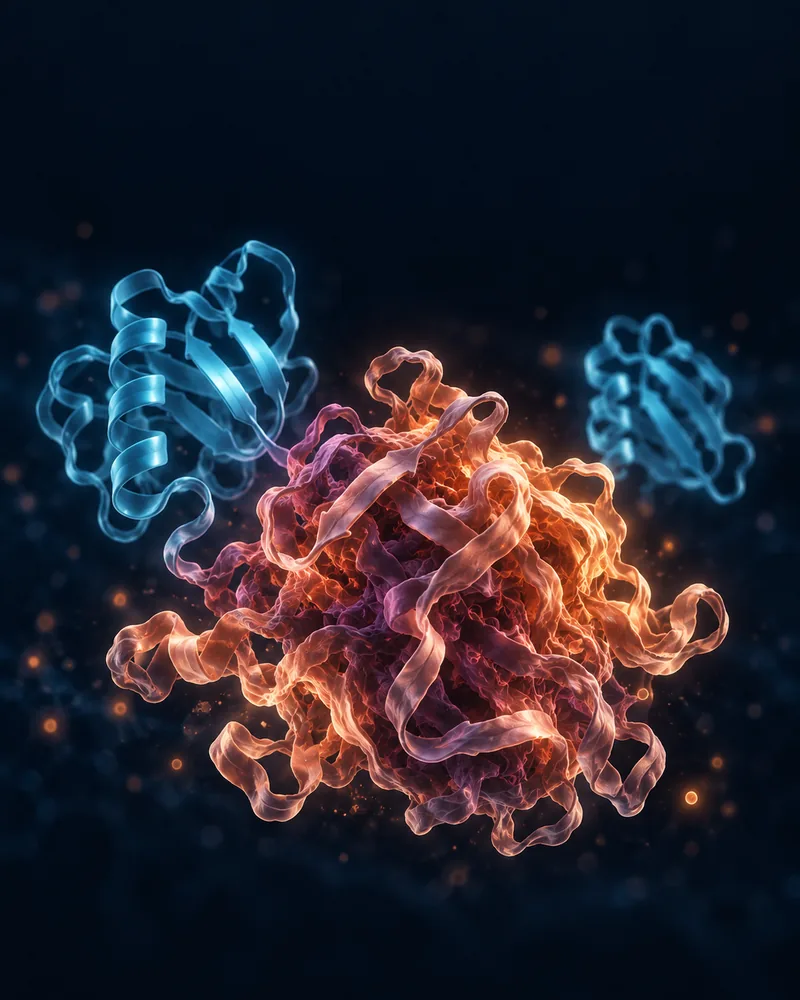
Folding is the whole game, and it fails more often with age. A protein is made as a plain chain of building blocks (amino acids) that then has to fold itself into one exact shape to function, like a strip of paper that only works once folded into a specific origami figure. Heat, oxidative stress (chemical wear from reactive oxygen species, the unstable oxygen byproducts of normal metabolism), and simple copying errors during protein-making all push proteins to misfold. A misfolded protein is not just useless; its sticky inner surfaces, normally tucked away, get exposed, so misfolded copies tend to glue to one another and to other proteins.
Molecular chaperones are the folding helpers and first responders. Chaperones are a class of proteins whose job is to help other proteins fold correctly and to grab ones that have slipped out of shape. The best-known are the heat-shock proteins (named because the cell makes more of them under heat and other stress), including HSP70 and HSP90. A chaperone either coaxes a damaged protein back into its correct fold or, if it is too far gone, escorts it to one of the disposal crews. With age the cell's chaperone supply and the stress response that ramps it up both weaken, so more misfolded proteins slip through.
The unfolded protein response is the cell's alarm for a folding backlog. A large share of proteins are folded inside the endoplasmic reticulum (the ER), a folding-and-packaging factory inside the cell. When misfolded proteins start to pile up there faster than they can be cleared, the ER triggers a coordinated alarm called the unfolded protein response (UPR), run by three sensor proteins named PERK, IRE1, and ATF6. The UPR briefly slows down new protein-making to ease the backlog and orders up more chaperones to clear it. If the overload is resolved, the cell recovers; if it drags on unresolved, the same alarm flips toward driving inflammation and ordering the cell to self-destruct.
The ubiquitin-proteasome system is the shredder for single damaged proteins. When a protein is beyond repair, the cell flags it for destruction by clipping on a chain of a small marker protein called ubiquitin, which works like a disposal tag. The tagged protein is then fed into the proteasome, a barrel-shaped shredder that chops it back down into reusable building blocks. This system handles most short-lived and damaged individual proteins, and its capacity falls with age, so tagged junk clears more slowly.
Chaperone-mediated autophagy is a second, selective disposal route, and it belongs to this hallmark. In chaperone-mediated autophagy (CMA), a chaperone called HSC70 recognizes a specific tag sequence on a worn-out protein, carries it one at a time to the lysosome (the cell's acidic recycling compartment), and feeds it through a dedicated gate protein in the lysosome wall called LAMP-2A. Because CMA picks off individual proteins, it sits inside the proteostasis hallmark. This is the key boundary to keep straight: CMA is part of protein misfolding, while bulk macroautophagy, the separate process that wraps up large clumps and whole worn-out structures for recycling, is its own distinct hallmark, autophagy decline. protein misfolding is about handling individual proteins and small cargo; the large-scale bulk cleanup lives in autophagy decline.
When clearance loses the race, proteins aggregate, and that is the damaging endpoint. If folding helpers and disposal crews cannot keep up, misfolded proteins stick together into insoluble clumps called aggregates. Several specific aggregates define major diseases: amyloid-beta plaques and tangles of a protein called tau in Alzheimer's disease, and clumps of a protein called alpha-synuclein in Parkinson's disease. These aggregates are both a consequence of failing proteostasis and a fresh source of stress, because they tie up chaperones and clog the disposal machinery, which makes the whole system fall further behind.