The hallmarks of aging · Whole-body effects

Disrupted cell signaling

Scientific name: Altered intercellular communication

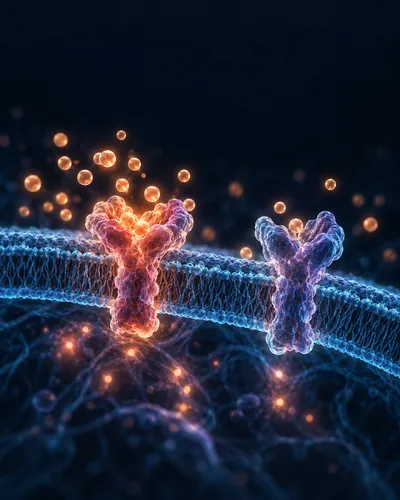
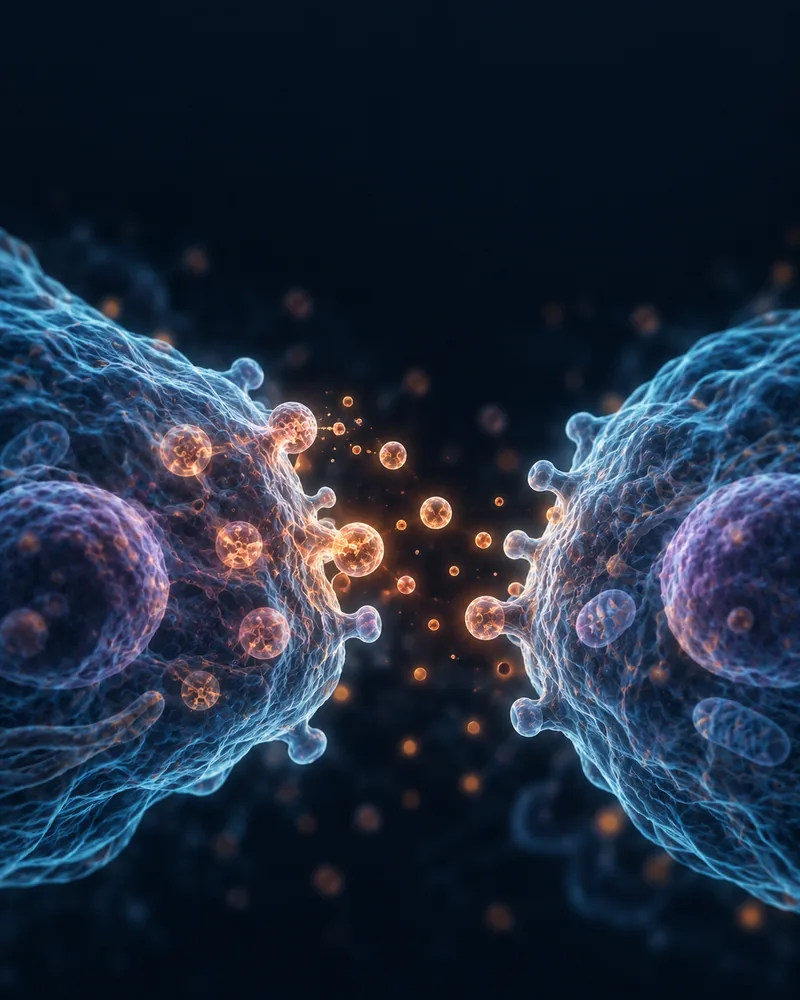
Cells constantly send each other messages: hormones in the blood, immune signals, the gas nitric oxide that lets blood vessels relax, and cues in the scaffolding between cells. With age these messages get noisier and tilt toward inflammation, so trouble in one tissue spreads to others.

Measurable today: in pieces, with hormone tests, blood vessel tests, and blood protein panels.

Why it matters

Why it matters to you

It is how local trouble spreads.

Signals from damaged and inflamed cells travel in the blood and can age tissues far away. In mice, sharing a blood supply with a young mouse restored repair ability in old muscle and liver cells.

Source: PubMed 15716955

Blood vessels are a main example.

The lining of blood vessels makes nitric oxide, which lets them relax. That signal weakens with age, and arteries tend to stiffen.

Hormone signals shift too.

Levels of hormones such as DHEA, testosterone, estrogen, and growth hormone change with age. Whether replacing them helps or harms depends on the hormone and the person.

Measurement

Can it be measured?

Hormone blood tests

Doctor-ordered tests

What it showsLevels of hormones such as thyroid hormone, sex hormones, DHEA-S, and IGF-1.

LimitsA level is a snapshot that shifts with time of day and health, and normal ranges were built to detect disease, not to track aging.

Blood vessel function tests

Specialist clinics and research

What it showsHow well the artery lining responds (flow-mediated dilation) and how stiff the arteries are (pulse wave velocity).

LimitsThese are not routine, and results depend on the technique and the lab.

Blood protein aging scores (proteomic clocks)

Research, some consumer tests

What it showsAn estimate of biological age from thousands of blood proteins. In 17,473 adults followed up to 28 years, such a score predicted death about as well as classic lifestyle risk factors.

LimitsThese are new. They predict risk in groups, and what a change in one person's score means is not established.

Sources: PubMed 42373948

What would make it measurable

  • Blood protein scores proven to track change in one person over time.
  • Simple, standardized tests of blood vessel function in routine care.
  • Trials showing that improving these signals improves health in older people.
What can be done

What can be done about it?

Thirty-two items in our catalog have human studies that support an effect on some part of this signaling, because it covers so many kinds of signals. Many act on blood vessel signaling, such as beetroot, cocoa flavanols, and citrulline; others act on hormones or on the scaffolding of joints. Acting on one signal is not the same as resetting the whole system, and no product has been shown to slow aging in people this way.

Three examples from our catalog, rotated daily: one with stronger evidence here, one with early evidence, and one where we found none. A sample, not a ranking or a recommendation. Ratings as of October 25, 2026. What the evidence levels mean.

Vitamins & Minerals

Methylfolate (5-MTHF)

Evidence for disrupted cell signaling: Supported

Human studies support it engaging this aging driver, short of the strongest trial designs.

Botanical

Bacopa Monnieri

Evidence for disrupted cell signaling: Emerging

Only early or animal-stage evidence for this aging driver so far.

Metabolites & Cofactors

PQQ

Evidence for disrupted cell signaling: None found

We did not find qualifying evidence that it engages this aging driver.

Its stronger evidence is for mitochondrial decline.

See the full picture for your own routine

The Longevity Intelligence Report shows how what you take and do covers disrupted cell signaling and the other hallmarks. Members also see every item in our catalog ranked by the strength of its evidence for disrupted cell signaling. Opens in December.

Get early access
New research

New studies on disrupted cell signaling

Picked for what they add to the biology, and to the chance of one day treating it, in plain words. Research checked October 17, 2026.

Disrupted cell signaling

Exercise loaded tiny blood-borne packages with a signal that helped old cartilage cells

People, older adults in a 3-month exercise program, plus mice and cartilage cells · Nature Aging · September 29, 2026

What they foundAfter three months of aerobic exercise, older adults' blood carried tiny packages (vesicles) richer in one gene-regulating molecule. In the lab these packages turned on a longevity-linked gene in cartilage cells, and injected into old mouse knees they improved cartilage health.

What it does not showThe benefit to cartilage was shown in cells and mice, not in the volunteers' joints.

Why it mattersIt shows one concrete way exercise sends signals through the blood to distant tissues.

Read the study on PubMed ↗
Exercise enhances aged chondrocyte health through microRNA-29-enriched extracellular vesicles.
Disrupted cell signaling

An aging switch in blood vessel lining drained a key fuel molecule and shortened life in mice

Mice · Science Advances · September 16, 2026

What they foundA pathway that grows more active in aging blood vessel lining cuts an enzyme cells need to make NAD+, a fuel molecule. Turning the pathway up aged blood vessels and shortened life in mice, and blocking it extended life.

What it does not showMice only, and much of it used engineered animals. The blocking drug is experimental.

Why it mattersIt suggests aging blood vessels can drive aging of the whole body, not only reflect it.

Read the study on PubMed ↗
Endothelial C/EBPβ/AEP pathway drives vascular deterioration and systemic aging.
Disrupted cell signaling

Blood proteins estimated the age of 40 cell types and predicted disease

People, 60,542 adults with blood protein data · Nature Medicine · June 15, 2026

What they foundFrom about 7,000 blood proteins, researchers estimated the biological age of more than 40 cell types. One in four or five people showed faster aging in a single cell type, and these signatures predicted disease and death over 15 years.

What it does not showThese are risk estimates for groups, not a test proven for one person. Two senior authors co-founded companies in this field.

Why it mattersIt shows the body's aging is uneven, and that blood signals can reveal which cell types are aging fastest.

Read the study on PubMed ↗
Plasma proteomic signatures of cellular aging predict human disease.

Follow the research on disrupted cell signaling

Pick the ones you want to follow. Starting in December, we'll email you every two weeks when new studies or new tests come out on them. Longevity Intelligence Report members also get the plain-English read on each one: why it matters, and whether it should change what you're doing.

Free, no account needed. We keep your email and the topics you pick, nothing else. Unsubscribe anytime.

From the articles

Articles on disrupted cell signaling

I Went Into Research to Study Aging. Then I Needed a Stent at 44.

What aging biology can tell us about the supplements, tests and habits we pay for: the 12 hallmarks of aging, plus a candidate 13th, in plain English.

Read the article →

Is Your Mouthwash Increasing Your Blood Pressure?

Some mouthwashes shut down the tongue bacteria your body uses to make nitric oxide. What chlorhexidine does to blood pressure, and which rinse didn't.

Read the article →

Aging's Zombie Cells Have an Inflammatory Fuel Line. Mayo Just Found the Valve.

Why zombie cells fuel inflammaging: a Mayo-led Nature study traces the mitochondrial fuel line that keeps inflammation genes open, and the valve that shuts it.

Read the article →

The Question No One Asked

A stent fixed my blockage. No cath-lab test could say whether a silent heart attack had already left a scar. Cardiac MRI can, and a stent doesn't rule it out.

Read the article →

The Plaque a Calcium Score Can't See

A calcium score only sees calcified plaque. Mine would have read zero with a severe soft-plaque blockage in place. What a 0 rules out, and what it doesn't.

Read the article →

The Gut May Be the Point: Metformin, Citrulline, and the Exercise Question

Metformin acts mainly in the gut, not muscle, per Nature Metabolism. That eases one exercise fear and raises a sharper one: less citrulline, less nitric oxide.

Read the article →

I Trained Hard for 25 Years. I Was Measuring the Wrong Fitness.

VO2 max carries one of the strongest survival signals in medicine, with no ceiling found. I lifted five hours a week for 25 years and never measured mine once.

Read the article →

Blood Pressure Isn’t a Moment. It’s a Dose Your Arteries Absorb for Decades.

132/85 is now Stage 1 hypertension, and a single reading is one sample of a dose your arteries absorb every beat, for decades. Mine sat there for twenty years.

Read the article →

What Twenty Years of “Borderline” LDL Actually Costs You

An LDL of 145 at 35 isn’t a snapshot. It’s 2,175 mg-years of exposure your arteries have already logged, and “borderline” is the word that hides the bill.

Read the article →
Go deeper

Connected hallmarks

How the biology works

The endothelium, the single-cell lining of every blood vessel, is a signaling organ, not just a pipe. A healthy lining makes nitric oxide (NO, a short-lived gas messenger) through an enzyme called eNOS, and that nitric oxide tells the artery to relax and widen, keeps the surface non-sticky, and quiets inflammation. With age, oxidative stress and inflammation strip nitric oxide out of the system, the enzyme can even start producing damaging byproducts instead, and the lining shifts to a stiff, sticky, inflamed state. This loss of nitric oxide signaling is endothelial dysfunction, and it is one of the earliest measurable signs of vascular aging.

Senescent cells (damaged cells that stop dividing but refuse to die), stressed immune cells, and visceral fat broadcast a cocktail of inflammatory messengers called the SASP (the senescence-associated secretory phenotype) plus tiny signaling packages called extracellular vesicles. These messengers travel through the blood and reshape how distant, otherwise-healthy tissue behaves, which is how local senescence becomes a body-wide signal.

The extracellular matrix, the protein scaffold between cells, stiffens with age. A major driver is advanced glycation end-products (AGEs, sugar molecules that bake onto long-lived proteins like collagen and cross-link them, the same browning chemistry as toasting bread). Stiffer matrix is not passive: it physically changes the signals cells receive, and AGEs also dock onto a receptor called RAGE that switches on inflammation. Arterial stiffening is the large-scale version of this, and it raises blood pressure and strains the heart.

Hormonal and brain-hormone (neuroendocrine) signaling drifts with age. Growth and sex-hormone axes decline, the insulin and IGF-1 growth signal stays inappropriately switched on amid constant food abundance, and low-grade inflammation in the hypothalamus disrupts the body-wide control of metabolism, appetite, sleep, the stress response, and the daily cortisol rhythm.

All of this converges on inflammaging: a persistent, low-level inflammatory hum in the bloodstream that is partly cause and partly consequence. It is the systemic signal noise of aging, and because the messengers circulate, a problem in fat tissue, gut, or a cluster of senescent cells can degrade signaling in the heart, brain, and muscle far away.

Where treatment research is heading
Next few years

Endothelial and nitric-oxide support through exercise and blood-pressure control

Regular aerobic exercise is the most reliable known way to keep the blood-vessel lining making nitric oxide, and tight blood-pressure control plus dietary nitrate from leafy greens and beets measurably improves how well arteries relax. These are low-risk, available-today levers with real cardiovascular outcome data behind blood-pressure control in particular.

Not ready yet: The improvements in endothelial markers are real but modest, individual responses vary, and a better flow-mediated-dilation number is not the same as a guaranteed drop in future heart attacks for any one person.

GLP-1 receptor agonists and their vascular effects

Drugs in the GLP-1 class (such as semaglutide and tirzepatide), developed for diabetes and weight loss, are now showing cardiovascular benefit in large trials and appear to calm vascular inflammation and improve endothelial signaling beyond what weight loss alone explains.

Not ready yet: These are prescription drugs with side effects and cost, the aging-specific (as opposed to disease-specific) benefit is unproven, and how much of the vascular effect is direct versus a downstream result of weight and glucose change is still being untangled.

Further out

Senolytics aimed at senescent cells in the vessel wall

Clearing the senescent endothelial and smooth-muscle cells that pump out inflammatory SASP signals could, in principle, quiet a major source of vascular inflammaging at its source. Early senolytic work (compounds like dasatinib plus quercetin, and fisetin) has improved vascular function in aged mice.

Not ready yet: Human cardiovascular outcome data do not exist yet, the right targets and doses are unsettled, and clearing the wrong cells could impair the vessel's own repair.

AGE-breakers and matrix-targeted therapeutics

Compounds designed to break the sugar-protein cross-links that stiffen arteries, an old idea revived by molecules such as alagebrium and newer matrix-targeted agents, aim to physically soften aged tissue and lower the signaling distortion that stiffness causes.

Not ready yet: Earlier AGE-breaker trials disappointed and the chemistry of reversing established cross-links in living tissue is hard, so durable human benefit on stiffness or outcomes is not established.

Klotho as a circulating anti-aging signal

Klotho is a protein the body makes that circulates in the blood and protects blood vessels, kidneys, and brain; higher levels track with better vascular and cognitive aging, and groups are exploring ways to raise or deliver it.

Not ready yet: Whether boosting klotho in humans produces real benefit is unproven, delivery of the protein is unsolved, and the human data are still associative rather than from intervention trials.

Long shots

Young-blood and plasma-factor approaches to reset circulating signals

Experiments sharing circulation between young and old animals (parabiosis) suggest the blood itself carries pro-youthful and pro-aging signals, raising the idea that rebalancing circulating factors, or removing harmful ones, could calm many hallmarks at once across the whole body.

Not ready yet: The specific helpful and harmful factors are still being sorted out, human plasma-based anti-aging products remain unproven and in some forms are actively marketed ahead of any evidence, and steering such a complex signaling network safely is far off.

Whole-body endothelial rejuvenation

Restoring the blood-vessel lining's youthful nitric-oxide-making capacity everywhere at once would, in principle, roll back a central engine of cardiovascular aging and improve blood flow to every organ.

Not ready yet: We have no way to safely and durably rejuvenate the endothelium body-wide, the lining is enormous and diffuse, and we do not yet know the youthful target state precisely enough to engineer toward it without unintended harm.

Facts and sources on this page checked October 17, 2026. This page explains research. It is not medical advice or a recommendation to take anything. How we grade the evidence.