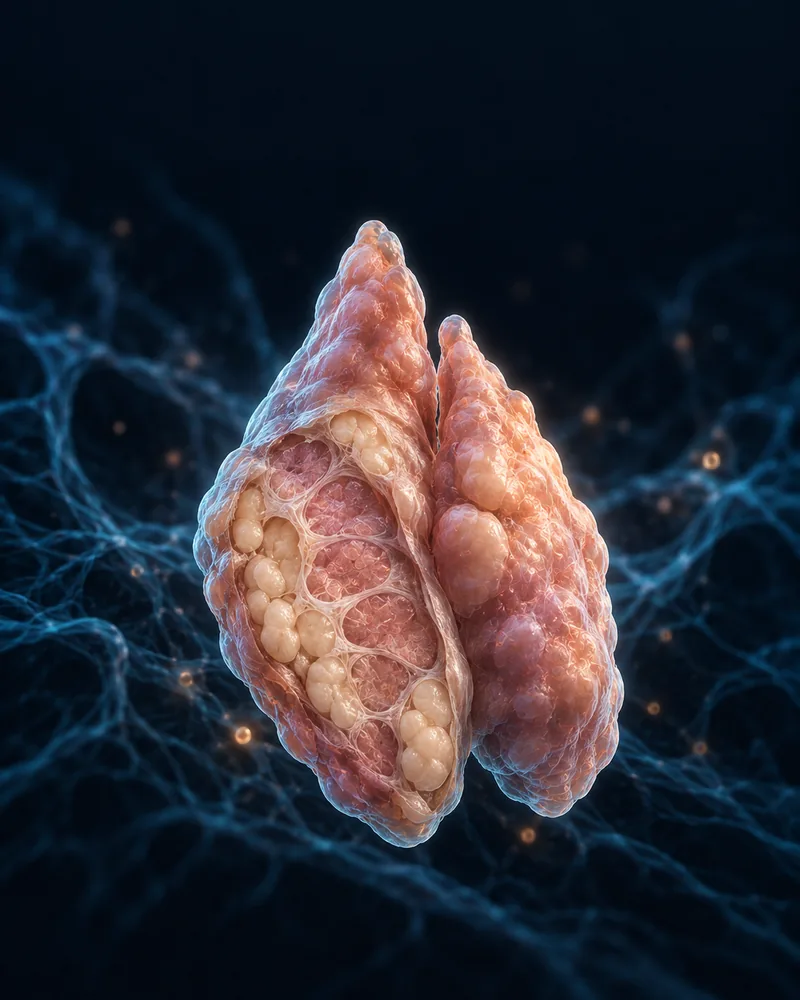
The thymus is the immune system's training school, and that is the core idea. It is a small gland sitting just behind the breastbone, and its job is to take immature immune cells delivered from the bone marrow and school them into working T-cells (the T stands for thymus). T-cells are the adaptive arm of immunity, meaning they learn to recognize specific threats rather than reacting in a generic way, and the thymus is where each new T-cell is both trained to recognize a target and tested to make sure it will not attack the body's own tissues, a quality-control step called self-tolerance. A T-cell that would attack the self is supposed to be culled here before it ever reaches circulation, which is why this organ is as much about preventing autoimmunity as about building defense.
Thymic involution is the unusual part: this organ ages first. Most organs hold steady until later life, but the thymus begins shrinking remarkably early, around puberty, and keeps shrinking through adulthood. Its working tissue, the specialized thymic epithelial cells that do the training, is gradually replaced by fatty tissue (a process called adipose involution), so the functional training space steadily contracts. By middle age much of the gland is fat, and by older age relatively little active training tissue remains. This early, lifelong decline is exactly why the organ draws attention as a possible driver, rather than just a passenger, of immune aging.
Falling output of naive T-cells is the central consequence. A naive T-cell is a fresh, fully trained but not-yet-deployed fighter, one that has never met its target and so is available to respond to a threat the body has never seen before. The thymus is the only place these are made, so as it involutes, the stream of new naive T-cells slows to a trickle. In adults the existing pool is topped up partly by naive cells slowly copying themselves in the periphery, but that is a workaround, not a replacement, and over decades the reserve of genuinely fresh, diverse cells shrinks.
The repertoire narrows and skews toward memory cells, which is the functional cost. The repertoire is the total variety of distinct threats the T-cell pool can recognize, and it depends on having many different naive cells, each tuned to a different target. As naive output falls, that variety narrows, and the immune system leans more and more on memory cells, which are veterans kept on file from past infections and vaccinations. Memory cells defend well against threats the body has already seen, but they cannot cover a genuinely new pathogen or a new vaccine, so an immune system dominated by memory and starved of naive cells is well-prepared for old fights and poorly prepared for new ones.
Reduced immune surveillance is the broader downstream effect. Surveillance is the immune system's constant patrol for infected cells and early cancerous cells, and it depends on having a diverse, responsive T-cell pool to catch unfamiliar threats. As the naive supply dwindles and the repertoire narrows, that patrol grows less thorough, which is one proposed reason infection susceptibility, poor vaccine responses, and some cancers rise with age. This is a plausible mechanistic thread, not a proven one-cause story, and the honest version keeps it as may contribute rather than does cause.
This ties directly into immunosenescence and inflammaging, the bridge to chronic inflammation. Immunosenescence is the umbrella term for the aging of the whole immune system, and it has two halves that move in opposite directions: the precise, targeted adaptive arm weakens (thymic involution is a major reason why), while the older, blunter inflammatory arm grows more trigger-happy. The net result is an immune system that is simultaneously worse at clearing real threats and quicker to fire off nonspecific inflammation, which feeds the chronic low-grade inflammation of aging (inflammaging). This bridge is a large part of why we track the thymus at all, because its decline is woven into the inflammatory hub that links aging to disease.