
Every study we could find on Urolithin A, checked against the biology of aging, with how it was tested and who paid for it. More intervention pages arrive here one at a time.
On January 1 the full library opens with the Longevity Intelligence Report. Enter everything in your routine, from supplements and medications to exercise and sleep, and you get your own dashboard and a personalized report showing:
- which items have real human evidence, and which only worked in a mouse
- which combinations could hurt you, like three supplements that all thin your blood
- which parts of aging nothing you take touches
- where you’re wasting money: two products doing the same job, or a dose nobody ever studied
You can search the whole library, every intervention and every study, and you hear about it when a new study or safety warning lands on something you take.
Urolithin A
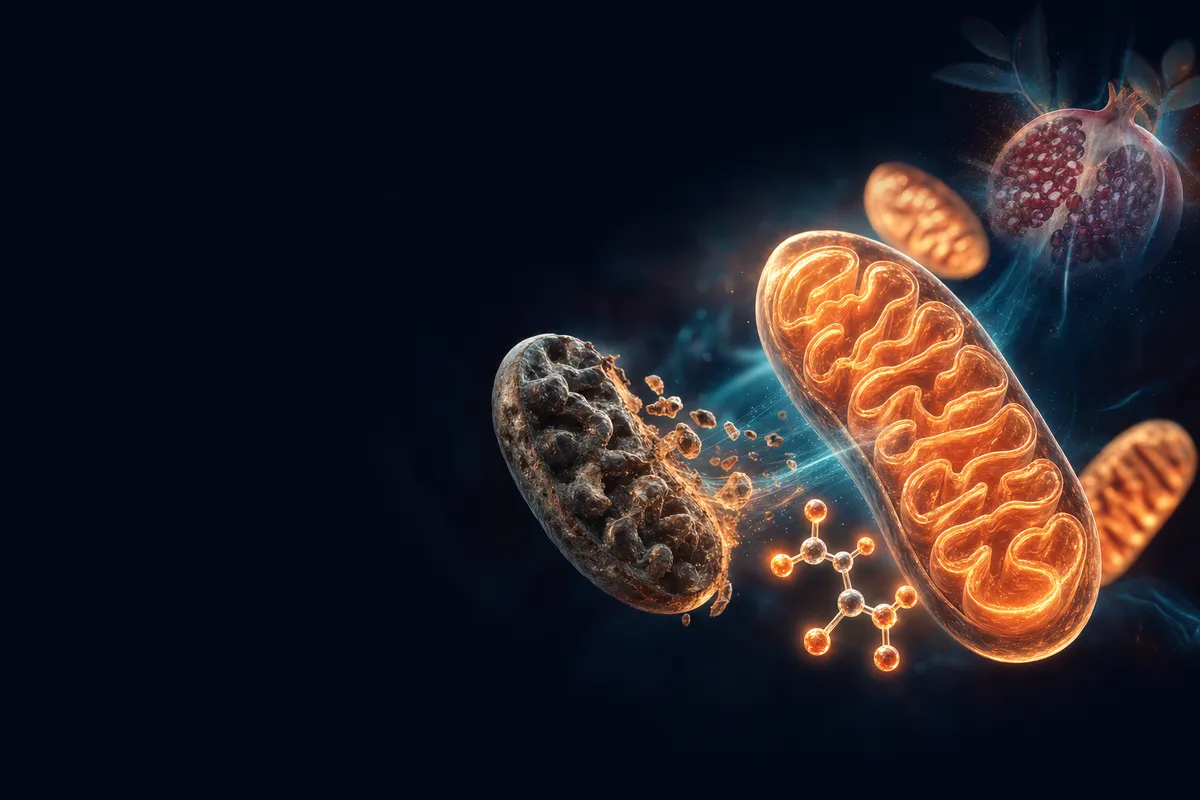
Mitochondria and recycling. A protein that drives new mitochondria rose in immune cells; a runner trial found no change.
Cellular energy. In a 4-month trial, muscle energy production did not differ from placebo.
Strength and muscle. Leg strength improved versus placebo in one trial; maximum lifts did not in another.
Urolithin A is a compound that some people's gut bacteria make from pomegranates, walnuts and berries, now sold purified and widely marketed for cellular energy and mitochondrial support and for muscle support. For those claims, trials found no change in muscle energy production, gains on some strength and muscle-endurance tests but not in walking or running, and mitochondrial marker changes in one trial but not another. Below, we look at the aging biology behind those claims.
None of those claims is about the gut microbiome, yet the strongest link to aging biology is there. In mice and human colon cells, urolithin A raised the proteins that seal gut-lining cells, and the effect disappeared when the receptor it acts through was removed. That action belongs to the gut microbiome, which researchers call dysbiosis, one of the thirteen hallmarks of aging. Absorption questions remain open: we did not find a study of how much urolithin A reaches the gut lining in people. When that mechanism is engaged at the doses where it has been demonstrated in laboratory and animal work, the result is tighter seals between gut-lining cells, directly relevant to the biology of aging. In people, one small trial paid for by a urolithin A maker found more varied gut bacteria than placebo on one measure. The next link is inflammation control, which researchers call chronic inflammation: a blood marker of inflammation was lower than with placebo in several trials. Urolithin A reaches the blood mostly in modified forms, which may explain weaker human than lab results; the absorption details are below.
We scored 13 human studies and 25 preclinical studies across mechanism, evidence quality, source and form, and conflict of interest dimensions to probe for signals relevant to the biology of aging. Evidence weight: moderate. The largest placebo-controlled trial, in inactive middle-aged adults, found an inflammation marker lower than placebo at the higher dose and fat-burning by-products lower at the lower dose. Its main measure, peak muscle power, did not differ. A majority of the human research on urolithin A was funded by or authored by researchers affiliated with the supplement's manufacturers, which we document transparently in the conflict of interest section below.
Some human evidence, short of our top rating. On cellular energy (mitochondria), more trials found no effect than found one. Results depend on the product's form and dose. The gut microbiome leads urolithin A's link to aging biology: in mice and human colon cells it raised the proteins that seal the gut lining, and a small trial in people found more varied gut bacteria. The energy and muscle claims rest on other trials, where mitochondrial markers moved but muscle energy did not. The data we would still like to see is an independent placebo-controlled trial in older adults measuring the gut lining and gut bacteria.
Trials of urolithin A taken by mouth found no change in muscle energy production, gains on some strength and muscle-endurance measures but not in walking or running, marker changes in mitochondria in one trial and not another, higher blood levels than from pomegranate juice in one trial, and a lifespan result only in worms.
A link to aging biology is not proof of a benefit.
Evidence across aging biology
Tap any aging system on the chart to see its mechanism strength and evidence quality.
Larger shapes mean higher ratings. They show the strength of the evidence, not the size of a biological benefit.
Rating for each aging driver
Each rating describes the evidence that Urolithin A engages that part of aging biology. It is not proof that it changes it in people at the doses people take.
Tap any aging driver for how it works, the evidence and the studies matched to it
Evidence Pyramid
Tap any level to explore the studies. Higher levels carry more weight in scoring.
We reviewed 38 studies (13 in people). 23 of them count toward a rating, including 7 of the 13 human studies. Each study card says what it does for the ratings.
No source checked returned a compound-level harm signal: in two placebo-controlled trials safety tests did not differ from placebo and in one adverse events did not differ, a systematic review reported mild or moderate unrelated adverse events, rat toxicology found no target organs, and the FDA raised no questions about a food-use notice; lab-only findings on platelets, estrogen receptors, drug-processing enzymes and transporters sit in Known Cautions as Worth knowing.
Not all-inclusive. Check with your prescriber or pharmacist before combining anything new.
We did not find a study of urolithin A supplements in pregnant or breastfeeding women. One single-ingredient label says not to take the product if pregnant or nursing, and a second says to ask a health professional first; neither label gives a reason. A 2022 review reports that urolithins made from food have been detected in human breast milk.
Single-ingredient labels say the product is for adults only and is not intended for anyone under 18; they do not give a reason. We did not find a study that assessed the safety of urolithin A supplements in children or teenagers.
The body converts most urolithin A into glucuronide and sulfate forms, which are the forms found in the blood. In lab studies with human colon cells, urolithin A raised the activity of two drug-processing enzymes, CYP1A1 and UGT1A10, and in a lab enzyme test it blocked a third, CYP1B1; in rats given urolithin A by mouth, the colon enzyme CYP1A1 did not rise. We did not find a study in people that tested urolithin A together with a medicine. Two single-ingredient labels tell people taking any medicines to ask a health professional before use.
In a lab study using blood from healthy volunteers, urolithin A added to the blood slowed platelet clumping, the first step in forming a clot, and added to the effect of aspirin; its glucuronide form, the main form in the blood after a supplement, did not have this effect. The authors state that studies in the body are needed to confirm it, and a computer model predicts that blood levels after supplements stay far below the levels that cause effects in lab dishes. We did not find a study of urolithin A supplements and bleeding or clotting in people. One combination product (urolithin A with resveratrol and other ingredients) tells users to stop two weeks before surgery; its label does not give a reason.
In lab studies with breast cancer cells, urolithin A bound to the body's estrogen receptors and acted both as a weak estrogen and as an estrogen blocker; a later lab study described it as a selective estrogen receptor modulator, and in that study's animal tests it did not make the womb grow. The authors of a computer model note that a few studies raise estrogen effects at high doses, and predict that the concentrations used in lab studies are unlikely to be reached in the body. We did not find a study of hormone effects of urolithin A supplements in people.
In lab and mouse studies, urolithin A lowered the pumps that push the chemotherapy drug fluorouracil out of resistant colon cancer cells, and the drug worked better against those tumors in mice; in another lab study, urolithin A was carried by one of these pumps and blocked it from moving the cancer drug mitoxantrone. In lab and mouse studies it also strengthened the immune cells that attack tumors, including engineered CAR-T cells. A 2025 review states that it may also promote immune tolerance, and another 2025 review calls for testing its combinations with chemotherapy and immunotherapy to determine safety and effectiveness. We did not find a study of urolithin A supplements in people receiving cancer treatment.
In a four-month trial in adults aged 65 to 90 taking 1,000 mg a day, side effects were varied, did not differ from placebo, and none were serious, with no differences in blood or urine tests. In a four-month trial in middle-aged adults taking 500 or 1,000 mg a day, side effects were varied, with slightly more muscle and joint complaints, mostly linked to the study's muscle biopsies, and no differences from placebo in vital signs, blood tests or urine tests. A systematic review of five human studies reported that side effects unrelated to urolithin A were mild or moderate. In 2018 the US FDA raised no questions about the maker's notice that urolithin A is safe in foods at up to 500 or 1,000 mg per serving; this is a food-use notice, not an approval of supplements. In rats, the highest dose tested for 90 days caused no harm, and urolithin A did not damage DNA in lab tests. The longest trials we found lasted four months.
- Pregnancy and breastfeeding: we did not find a study of urolithin A supplements in pregnant or breastfeeding women; one single-ingredient label says not to take the product if pregnant or nursing. (Dual-cited with Known Cautions.)
- Under 18: single-ingredient labels say the product is for adults only. (Dual-cited with Known Cautions.)
- Product form: products differ in whether they supply urolithin A itself or a pomegranate or ellagitannin extract that relies on gut bacteria to make it. (Dual-cited with Source & Form Matters.)
How It Works (Mechanism of Action)
A mechanism is not a result. These steps come mostly from cells in a dish and from animals. Whether any of it happens in your body is a separate question: sometimes it never reaches the tissue, and sometimes the lab used a dose no person would ever take.
The steps that link Urolithin A to the aging drivers on this page, as the studies describe them. Tap any step for the details.
Urolithin A appears to help cells clear out damaged mitochondria and to tighten the gut lining, two effects shown so far in cells and animals. In people taking the doses sold, trials measured blood and muscle markers of mitochondria and of mitophagy, not the clearing itself or the gut lining, and we did not find a study that measured how much urolithin A reaches the gut lining or compared measured blood levels with the concentrations used in lab dishes.
Urolithin A raises mitophagy, the cell's recycling of worn-out mitochondria: in worms, mice and cells it increased the clearing of damaged mitochondria, and in stressed hearing cells that clearing fell when the mitophagy proteins Parkin and BNIP3 were switched off, although we did not find a study naming the protein it binds to start the process. Separately, in mice and in human colon cells it raised the proteins that seal gut-lining cells, an effect lost without the aryl hydrocarbon receptor (AHR), a sensor for small molecules from food and gut bacteria; it bound the human form of this receptor in a lab test, and papers differ on whether it switches the receptor on or blocks it.
Bioavailability
How much of the compound reaches the blood.
This section describes the forms and doses used in research. It is not a recommendation to take Urolithin A.
Source & Form Matters
Two products with the same name on the label can contain materially different molecules. For this compound category, source and form affect what you actually get.
- Whether the product supplies urolithin A: in a trial comparing a direct dose with a glass of pomegranate juice, only a minority of healthy adults had urolithin A in their blood at the start, and fewer than half made meaningful amounts from the juice.
- What the label states: in a lab test of products bought online, in pharmacies or from makers, four that claimed urolithin A held amounts from somewhat below to somewhat above their labels, and a pomegranate extract held none.
- Other ingredients: some products combine urolithin A with resveratrol, coenzyme Q10 or betaine, combinations the trials on this page did not test.
Dosage Details
What doses, forms, and timings showed up in the published research.
Funding and conflicts of interest
Of the 11 human studies whose funding and conflicts we could check, we found ties to a company that makes or sells this ingredient in 7 (64%); 4 have no such ties that we found. We couldn't read the other 2 in full.
Results by funding. From each human study's result on the aging drivers it is matched to on this page. Studies with ties we found: 2 positive, 3 mixed, 1 no effect. Studies without: 1 mixed, 2 no effect.
A company tie is a fact to weigh, not proof a result is wrong. Funding never changes the evidence ratings on this page.
We found 20 granted US patents on forms or uses of this ingredient (20 in force, 0 expired; checked November 2026). A patent is a public record of who owns an invention. It does not show whether a study's results are right.
- US10442784 ↗ · In force · Compositions comprising an urolithin compound · Owner: Amazentis Sa
- US10695320 ↗ · In force · Compositions comprising urolithin compounds · Owner: Amazentis Sa
- US10906883 ↗ · In force · Process-scale synthesis of urolithin A · Owner: Amazentis SA
- US10988453 ↗ · In force · Compositions comprising an urolithin compound · Owner: Amazentis SA
- US11166972 ↗ · In force · Compositions comprising nicotinamide riboside and a urolithin · Owner: Amazentis SA
- US11337957 ↗ · In force · Compositions comprising urolithin compounds · Owner: Amazentis SA
Showing 6 of 20.
Are you an author of one of these studies? If we got your funding, conflicts or a patent wrong, email corrections@calibratedsignal.com with the study and we will correct it within a week.
Epigenetic clock studies
Related Clock Studies (Not Mapped)
Biological aging clock studies that included Urolithin A as one of several components tested.